
When Amaarae made her debut at the Coachella Valley Music and Arts Festival in April, she strode onto the stage with a look of fearless intent in her eyes. Clad in a militant black two-piece, towering boots and a bust-down middle part wig (which she rebelliously shaved off onstage), she stood at the center of Ghana’s flag as it unfurled behind her, pulsating in the desert wind.
“Ghana is in the building. Y’all don’t even know,” she told the audience after performing some of her biggest hits, including “Sad Girlz Luv Money,” and previewing new music. She also played a handful of her favorite tracks by fellow Ghanaian artists such as Joey B, Asakaa Boys, Eazzy and La Même Gang. As the first Ghanaian solo female act to perform at Coachella, she was fully aware that this historic moment on one of the largest global stages was much bigger than her.
“I remember walking offstage and just feeling like, man, there was so much pressure all day. There were so many things that went wrong behind the scenes and it was really difficult to get to the performance,” Amaarae, 31, tells The Times over Zoom.
“But after I got off, I was like, ‘Wow, this is something I’ve always wanted my whole life,’” adds Amaarae, who went on tour with Sabrina Carpenter last year. “And to be the first flag bearer for my country was so fire.”
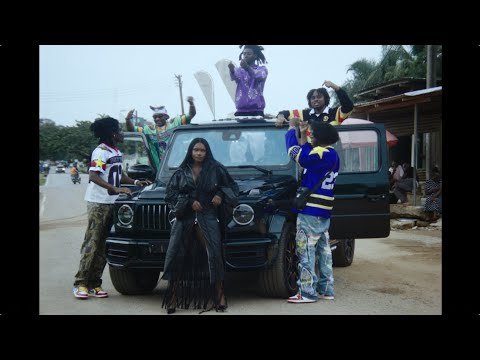
Although Amaarae, who was born in the Bronx and raised between the United States and Ghana, has always repped Ghana in her music, her third album, “Black Star,” is by far her most fearless and culturally resonant work to date. Released in August, the genre-busting dance album is oozing with Ghanaian pride from its cover (Amaarae stands in as the black star in the country’s flag) to a feature from fellow Ghanaian singer-rapper Bree Runway. Amaarae also shot the music video for her track “Free the Youth” at Independence Square (also known as Black Star Square) in Accra — a feat that she didn’t think was possible, “but somehow it happened,” she says.
Blending various musical styles together over Amaarae’s distinctive high-pitched vocals, “Black Star” is also a masterclass on Black diasporic dance music. With high-energy production and pleasure-soaked lyrics, she infuses Brazil’s Baile funk, Detroit’s ghettotech, Chicago house and Jersey club while also tapping further into Ghana’s regional microgenres.
“When I work with people, they always want to try their most experimental stuff with me and I love that,” says Amaarae, who included features from supermodel Naomi Campbell, “Uncle” Charlie Wilson and singers PinkPantheress and Zacari on the album. She teamed up with folks like Bnyx — who has made beats for artists like Yeat and Drake — on her high-energy tracks “Fineshyt” and “S.M.O.” and Spanish producer El Guincho — who has worked with Camila Cabello — on “Starkilla” and “She Is My Drug.”
As part of a mini tour before the official one, Amaarae is bringing the “Black Star Experience” to life on Thursday at the Hollywood Palladium — an event she says “might start as a concert and end as a sermon.” With Amaarae — who’s a Cancer sun, Pisces rising and Gemini moon — you just never know which direction she’s going in, so it’s best to leave your expectations at the door, she says.
In this unfiltered conversation, Amaarae opened up about being embraced by her homeland after years of feeling misunderstood, why she thinks only a handful of artists are worthy of the title “pop star,” how a recent death in her family has shifted her perspective on life and work, and what’s giving her hope these days.
This conversation has been edited for length and clarity.
At one point during your Coachella set, singer Amindi came out to shave your head and afterward you said that you were “finally free.” What were you releasing in that moment and what did freedom look like for you?
I was just kind of shedding my old skin and I think that that was such a great place to do it because there’s so many eyeballs, and I knew that, if not anything else, everyone from Ghana was watching. I think I’ve done a lot of firsts for Ghana and for Africa in general. And I think that I’m maybe one of the few or one of the only artists who carries being genre-bending, leaning into and supporting the queer community with my music and art, and also defying the status quo of what it is to be a typical African. I felt like I was really shedding that and communicating to a lot of girls that there’s a freedom when you allow yourself to truly become who you’ve always wanted to be. And I feel like leading up to “Black Star,” I always kind of felt pressured, in a way, to present and be a certain way, especially because everyone around me would be like, “You’re still an African at the end of the day,” and I think when I got to that point, I said, “Everyone can suck my d—. I’m just gonna do what the f— I want to do.” [laughs]
You’ve said that returning to Ghana last winter made you realize that your relationship to home had changed. Can you take me back to that moment and what it felt like to finally be understood and embraced on your own terms?
It was shocking. I go back to Ghana every December, but I was living there up until about 2022 and I feel like I always had a resistance from the general public of like “Oh, you’re so different. You’re not one of us.” And going back home in December 2024, it was really different. I could tell people were really proud, like, “Against all odds, you got there. You also did so on your own terms.” And the most surprising thing is that I’ve had a lot of women who are older than me be like, “You’ve done something very aspirational and inspirational.” My aunts and my grandmothers always get together to watch every performance. Like recently, when I did “Kimmel,” they all got together in Maryland and were watching it, and sent me a video. When that happens, I feel like they think that everything that we went through to give birth to our children, to get them to America, to educate them, to pay their school fees, to pay their college, it’s paying off, because they are now kind of shedding some of the generational curses, and they don’t have to pay for the mistakes that we’ve made anymore. So it’s almost like being anew and I got that a lot from a lot of my aunts and a lot of my mom’s friends, they were the most proud. I feel like it’s because a lot of them have sacrificed a lot. So to see that their children can now become and do what they want to do and live life on their own terms, I can only imagine how fulfilling that must be.

“For me, including my community in the rollout and having them see themselves not only in the music, but also visually in what’s happening, is a dope gift to give to your fans,” Amaarae said.
(Ryan Armes)
You’ve spoken about how you tapped into an alter ego on “Black Star.” While you’re more of a homebody in your personal life, “Black Star” is very much a “we outside” type of album from the high energy of the production and the in-your-face lyrics. Can you talk about why you wanted to bring out this other side of yourself?
A lot of people don’t know that I began as a rapper and singing kind of happened because my cousin, who taught me how to make beats and shoot videos and edit videos, was a popular rapper in Ghana. He was like, “You suck at rapping and you also don’t have a great speaking voice for rapping, in my opinion, but there is something that you tap into that sounds like an auto-tune chipmunk. I think you should take your raps and sing them like that.” So I feel like, as I was developing the artist on Amaarae, I was more of a singsongy kind of singer, but I’ve always had this, like, rap alter ego that I don’t really tap into. I might tap into it on a feature. I kind of got tired of, like, “Oh my God, every time it’s romantic and it’s sad,” and I was like, “Man, f— it.” I just want to rap and I just want to tap into this kind of, like, mischievous character that I don’t think has really come out on any of my other projects. I’ve always had this interest and I’ve always had this expression and I feel like I quieted it or numbed it, and I just wanted people to know that this is another part of who I am. I do have a split where I can get bad and mischievous and I’m just outside and wreaking havoc, but that’s like something that’s also very internal that you have to be close to me, or around me, to see and to know.
As part of the rollout for “Black Star,” you hosted livestreams in L.A. and a few other cities, which were essentially parties where you gave fans a taste of the music. Why did you want to promote your album in this way?
I feel like Amaarae music brings the girls out, so for me, when it was time to do “Black Star,” I’m like who better to call up all the girls and be like, “Do y’all wanna hear some new s— and how do you feel about it?”’ The girls will literally come up to me and be like, “I like when you did this. I think you should take this part out,” so they were giving me notes as they were in the vibe of it all. I took a lot of their notes and made a lot of changes based on that because I be making music for the girls for real. So I don’t want to hear anybody else’s opinion besides the damn girls. So if I was in New York, I was like, “All the girls pull up in all black and let’s shoot a visualizer for ‘S.M.O.’” If I’m in Paris, I’m like, “All you girls pull up. Let’s shoot something for ‘Ms60.’” If I’m in Ghana, I’m like, “All the girls pull up, and let’s just throw a party,” and then that turns into “B2B.” For me, including my community in the rollout and having them see themselves not only in the music, but also visually in what’s happening, is a dope gift to give to your fans.
You are bringing the “Black Star Experience” to the Hollywood Palladium on Thursday. Why did you want to share your album in this way rather than hop into the tour right away?
I think we picked the cities that have shown the most love throughout this rollout. The first “Black Star” stream started off in L.A., so it’s like, might as well bring it back. New York, we did the Lot party, so we wanted to do that again. Then the last one is going to be in Ghana because I have to bring it home. I haven’t performed in Ghana in the last five years, so I felt like, yeah, this is a really important time to give the people that. I also just wanted to do a concert and have fun. I wanted to do a concert that didn’t rely on, like, “Let me do a bunch of choreo and whatever.” I’m, like, put some lights on, throw some music on and we’re just gonna rage. I think that I’ve seen the fans really enjoy just kind of the raw aspect of that as well.

“I probably maybe have one more album in me, and then I don’t want to see or speak to anybody ever again,” Amaarae said.
(Ryan Armes)
What can people expect from the show?
I don’t think you should come with any expectations, to be honest. The same way the music is exploratory is the same way the show is going to be exploratory. We’ve been building the music for that and it’s a lot of surprises and curveballs thrown in. So I don’t want to give away too much, but it might start as a concert and end as a sermon.
You’ve been able to navigate the global pop space without losing your identity throughout your career. What does being a pop star mean to you today and has your idea of success changed as your fanbase has grown?
The idea of being a pop star to me right now doesn’t mean s— because … how do I say this in the most respectful way possible? [laughs and takes long pause] Every day, I wake up with Rihanna on my mind or Beyoncé on my mind or Janet Jackson on my mind or Madonna on my mind. I’ll just say that I don’t wake up with anyone that is currently existing as a pop star on my mind, so I think that speaks to the quality of the talent pool and also the desire for current pop stars to really be true trailblazers and game changers. I think the concept of what a pop star is has completely shifted more in the direction of what is palatable to social media. And so I don’t know if people are putting in the same effort, rehearsal, time, energy, thought into that. I don’t know that there are any people currently deserving of the title of what those such as Michael, Prince and Beyoncé, Rihanna and Madonna have all once held, so hopefully we come to more improvements in that space.
You’ve been in this industry for 10 years now. How do you envision your next 10 years and where are you at mentally at this point in your career?
Truthfully, I don’t know if I believe deeply in the future of music any longer, so as a result for me personally, I can try as much as possible to be the change that I want to see, but I think for me that will only last for so long. So for me, for my next 10 years, I just want to pour into the concept of building a very wonderful family, the concept of creating spaces back home that can support and teach and nurture creativity, and also give people the tools to properly navigate the music industry where their mental, physical and emotional health is also considered. And I probably maybe have one more album in me, and then I don’t want to see or speak to anybody ever again.
Wow, just one more?
Yeah.
That’s shocking. Is this a new revelation or something you’ve been sitting with for a while?
Well, my stepmother just passed from cancer, and we’re all a very close family. I go home once a year for two weeks, so I’ve missed weddings, birthdays, gatherings and, worst of all, my stepmother was deteriorating, and I really wasn’t able to speak to her for the last six to eight months because I’ve been so wrapped up in work. So when she died the day before the Grammys were announced, that completely shifted my perspective of, like, what do I really care about? And I realized that what I do care about is my family and having that kind of time for them, and I haven’t been able to do that and being so far away. But it’s like everything that I’m doing is for my family and in respect to my family and honoring my family name, and being able to protect and provide for them, and then my stepmom dies while I’m doing all of that. It’s just the way I think about what I’m doing and why. So yeah, I don’t know. I think that was a very emotional time for me and it just completely changed the way I was thinking about what I was doing.
I’m so sorry for your loss. Thank you for being open enough to share that. Given that you have been balancing and dealing with so much, what is keeping you going these days and what’s been exciting you?
Two things: I recently listened to this album called “hooke’s law” by KeiyaA. It caught me at the perfect time and it just gave me hope in music again and in art. It made me think a lot about my existence as a woman and as a human being, and it really was cathartic for me. She wrote, produced, arranged all of that music and that was incredible to remember that there are still people who are creating from the heart and from the soul, and whose message is also very specifically Black. That’s a very important thing.
I also recently learned about this experimental jazz pianist Precious Renee Tucker and I’ve been following her. I’m just like, “Right, I have to remember that there’s geniuses. There’s geniuses still out there.” And for me, a lot of the geniuses that I’ve been seeing recently are Black women who are just doing incredible things in art and music. Solange just did a library event in New York where Precious Renee Tucker was the opener and she played piano, so those are the things that are giving me hope.